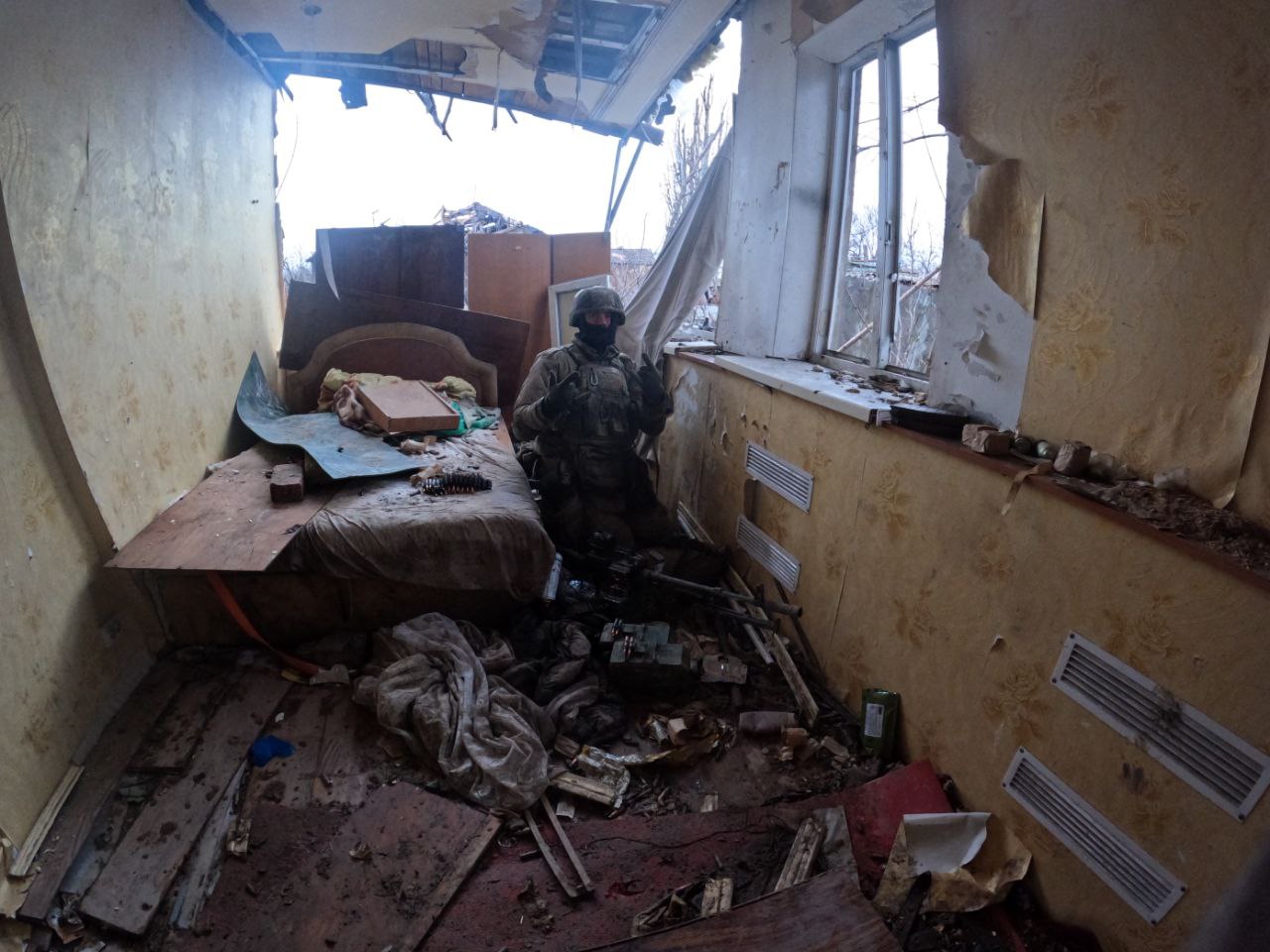
His most recent project, Red Horse, is named after one of the four horsemen of the apocalypse; the rider on the red horse is the harbinger of war, the steed’s colour is the colour of blood. Made since February 2022, Kurmaz’s photographs are lo-fi, aesthetically close to family snaps but showing scenes that are anything but. There is shocking violence, tangled bomb craters where homes used to be, bodies tortured and left to rot. There is also the unspectacular, the quiet absurdism of the quotidian experience of war. There’s a wine glass melted Salvador Dalí-style, all that’s left of a friend’s apartment. There’s a man towing a cooker down the road in a bath. Some of the images are near-abstract, difficult to read; others include colour washes, rendering whole views blue, or green, or horrorshow red.
Occasionally Kurmaz intersperses his photographs with found images, from newspapers or famous paintings. There’s a front page featuring Vladimir Putin, renditions of heroes made by the army; there are snippets of The Triumph of Death, hellish scenes painted over and over by Pieter Bruegel and his son. Photographs of war circulate in our culture, in propaganda, fiction and news, so familiar we no longer see them, so sleek our eyes slip off into the view. Older paintings, with roots in religion, retain atrocity but are stymied by their place in art history. They’re canonical, fusty remains, faintly comic or ludicrous.

Throughout Kurmaz stages his images, roughly taping them onto found cardboard and paper. These fragments add frames to the shots, emphasising the edges of the photographs, the fact they are actually prints; the found materials also retain the shock of the real, the sense they are from the place. In one Kurmaz even adds his own hair. Photographs are records but they’re not artefacts, what they show is safely contained within borders and behind a fourth wall. But Kurmaz’s experiences can’t be contained. They leak out from images. Red Horse is rough-round-the-edges, DIY, crude; it’s human rather than slick. Kurmaz is not a professional photojournalist, and his photographs are less slippery because of it.
His experiences are also firmly his, identified with his individual, subjective life. Kurmaz doesn’t stay hidden behind the lens, or adopt a view from apparently nowhere. Sometimes his shadow bleeds into the frame, or his hand reaches into sight; that hair is literally there. He adds notes directly onto the pieces, diaristic and deeply-felt, handwritten not rendered in font. They express doubts and fears rather than caption information. Kurmaz admits he’s reluctant to fight, and questions his own reticence, amid the destruction of so much he loves. Red Horse is also huge, the book some 800 pages long and installations of it similarly overwhelming. Like a diary it’s driven by compulsive need, a daily urge to express, or to try to make sense of the incomprehensible.

Rationality depends on repetition, the logic of the test and hypothesis. What to do when every day brings new shocks and outrage? When even those shocks become normal? How to convey this experience? Photography puts us at a remove, stirs feelings but leaves us ultimately literally untouched. Kurmaz’s exhibition Contemplating the Empathy of Others at Lauenburger Künstlerhaus, Germany in 2024, worried at the latter, combining the Red Horse collages with music, performance, and dance to appeal to senses beyond sight alone. The title evoked Susan Sontag’s Regarding the Pain of Others, but Kurmaz emphasised on those inside looking out.

The smell of burning bodies never leaves you, writes Kurmaz, and though he evokes the idea of empathy, he knows it’s not experience. “It took me two weeks to accept the peaceful European reality after my first trip abroad since the invasion,” he notes. “But it took me even longer to understand that a person who has not been personally traumatised and has not been inside the war can’t have this experience and I can’t demand it from others.” I’m writing this text in London, blanket on my knees as my son games. What do I know about how war sounds, smells or feels?


But, though war has thrown them into relief, Kurmaz has long circled similar questions. A 2017 installation in Besançon also referenced Sontag in the title The Pain of Others; made with and for refugees, it included DIY banners and graphics, photographs, found images and flowers. “The pain of others titillates us, so long as it is kept at a safe distance,” read a central sign. His earlier work Ultras (2010-2012) is a series of screenshots of football hooligan fights, originally shot on mobile phones. Recorded and posted online by fans, this footage was designed to enjoy without feeling the boot in the face.
Elsewhere Kurmaz has explored more literal titillation, the insidious soft edges of erotica; he calls his earliest publications “funzines”, and they focus on embodied, physical pleasure. Concrete and Sex (2013) features youthful nudes, political icons and flags; the images of naked bodies are transgressive, sexy, apparently in direct contrast with the signs. In one shot a framed portrait of Aleksandr Lukashenko is propped up between two nubile thighs. “Just look at what’s there and respond to it – just explain how you feel about it, there’s no need to be too fancy,” Kurmaz instructed a friend writing the essay for the zine. But the viewer isn’t touching all that skin; we can’t feel the warmth or caress.

My First Love (2011/12) features shots of crotches, printed with thermochemical paint; this paint becomes transparent when the temperature changes, so Kurmaz encourages viewers to get involved, to rub images of underwear until flesh is revealed. It feels subversive, more taboo than simply looking, though actually we’re still not there. Can we touch a stranger’s genitals in photo form? Lust (2020) gathers found images from the internet; shot in post-Soviet interiors, they are pornographic but vernacular, DIY. They have a readers’ wives edge. Perhaps part of the thrill is the authenticity, because these men and women are close to everyday life, not professional models staging fantasies. Yet the repetition in their poses suggests they also re-enact tropes, commodifying themselves for consumption and cash.

War porn and porn porn make voyeurs and gooners of those who look. But though we’re distant perhaps we’re not always passive spectators. It’s just that this gaze is inside our heads when we act. It’s changing how we fight and fuck. Are you having sex or presenting your body to view? Killing another human or deleting a shot? Snipers see the world behind glass and in-frame in a viewfinder; drone operators see the results of their actions on-screen. It makes it easier to do unspeakable things. Kurmaz’s 2022 project Target shows routine scenes as viewed through the crosshairs of a scope; they suggest someone or something watching and not only that. They suggest ominously readying shots.
Of course similar critiques have been made of photography through its history, by Sontag, Jean Baudrillard, Ariella Azoulay and many more. But Kurmaz is not just testing ideas. He’s bringing his body and soul. Red Horse includes a photograph of an FPV drone loaded with explosives, above a shot of a dead man in army uniform. “A cheap and effective killing tool used as a suicide drone against military equipment and infantry,” writes Kurmaz, adopting the calculating, rational voice. A few pages later he shows a pixellated image of a bloodied face and notes; “War is a machine for turning personalities into abstraction.”